Coastal engineering record
Lighthouses of Britain and Ireland
Five rock and headland stations trace the development of lighthouse engineering across two centuries: how towers were shaped to survive the sea, how their foundations were cut into reefs and stacks, how their optics evolved, and how three separate authorities took responsibility for keeping them lit.
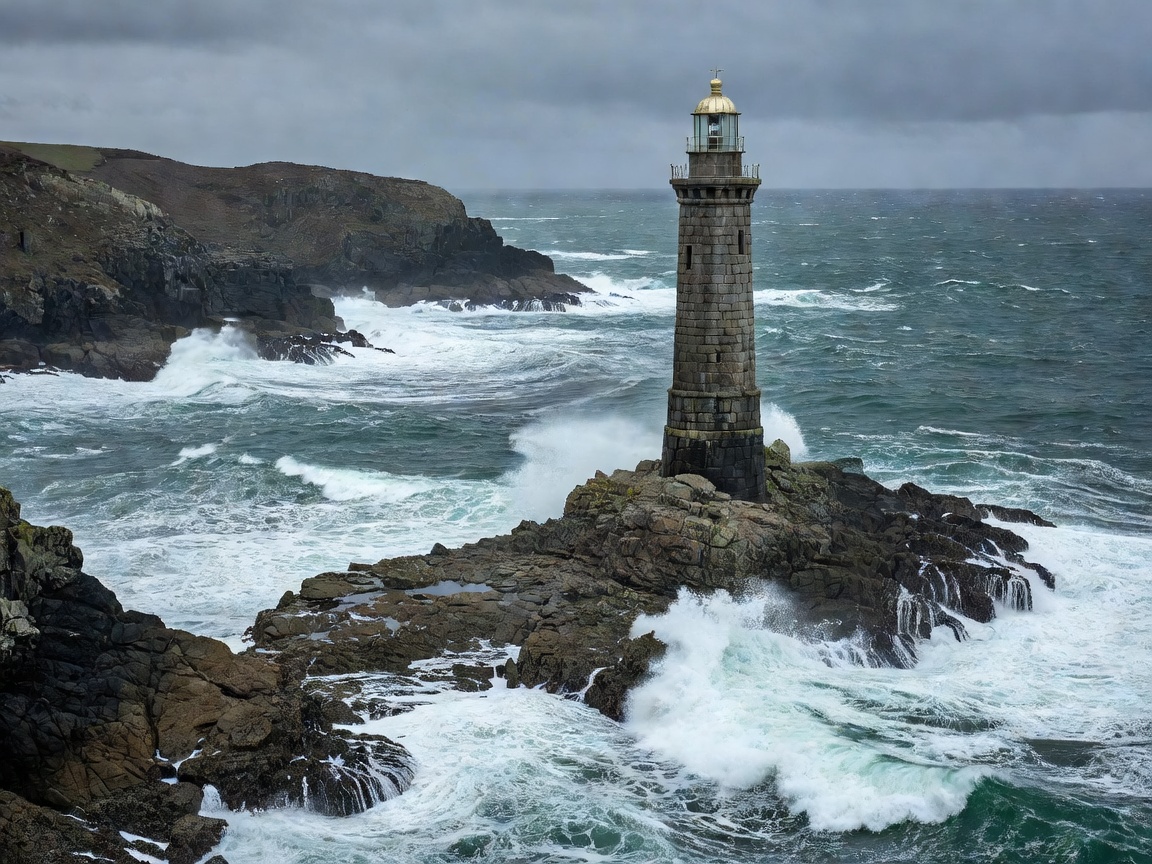
The five stations
-
01
Eddystone
Four successive towers on the Eddystone Rocks off Plymouth, from Henry Winstanley's timber structure through John Smeaton's dovetailed granite tower to the current James Douglass design, illustrate the shift from experimental to standardised rock-tower construction.
Read the Eddystone record -
02
Bell Rock
Robert Stevenson's tower on the Inchcape reef off Arbroath, built between 1807 and 1810 with John Rennie as consulting engineer, is among the earliest surviving lighthouses built directly on a submerged rock rather than an island or headland.
Read the Bell Rock record -
03
Skerryvore
Alan Stevenson's tower on a reef southwest of Tiree, completed in 1844 and built from granite quarried on Mull, is the tallest lighthouse in Scotland and was rebuilt internally after a fire in 1954.
Read the Skerryvore record -
04
Fastnet
The granite tower on Fastnet Rock, completed in 1904 to William Douglass's design and replacing an earlier cast-iron structure, marks the point where emigrant ships last sighted Ireland and still gives its name to an offshore yacht race.
Read the Fastnet record -
05
South Stack
Daniel Alexander's 1809 tower on a tidal islet off Holy Island is reached by a footbridge and a long flight of steps, and stands beside seabird colonies now managed as an RSPB reserve.
Read the South Stack record
Three authorities, one coastline
Responsibility for lighthouses around Britain and Ireland is divided among three General Lighthouse Authorities. Trinity House covers England, Wales, the Channel Islands and Gibraltar. The Northern Lighthouse Board covers Scotland and the Isle of Man. The Commissioners of Irish Lights hold an all-island remit covering both jurisdictions in Ireland.
Each body grew out of local pilotage and harbour trusts before consolidating into a single lighthouse-owning authority for its area during the eighteenth and nineteenth centuries. Their engineers, including successive generations of the Stevenson family for the Northern Lighthouse Board and William Douglass for the Commissioners of Irish Lights, moved between rock stations, carrying construction methods from one project to the next.
All three authorities converted their staffed stations to automatic operation over the twentieth century, a process that changed the shore-based logistics of lighthouse keeping without altering the towers or their optics. Today the authorities retain responsibility for the aids to navigation described across these pages, monitoring them remotely rather than from resident keepers' quarters.