County Cork, Ireland
Fastnet Lighthouse
Fastnet Rock stands around thirteen kilometres off Cape Clear Island, the southernmost point of Ireland's coast on many charts. Two towers have stood there since the mid-nineteenth century, and the current granite tower, completed in 1904, is the last of the great dovetailed rock lighthouses built in these islands.
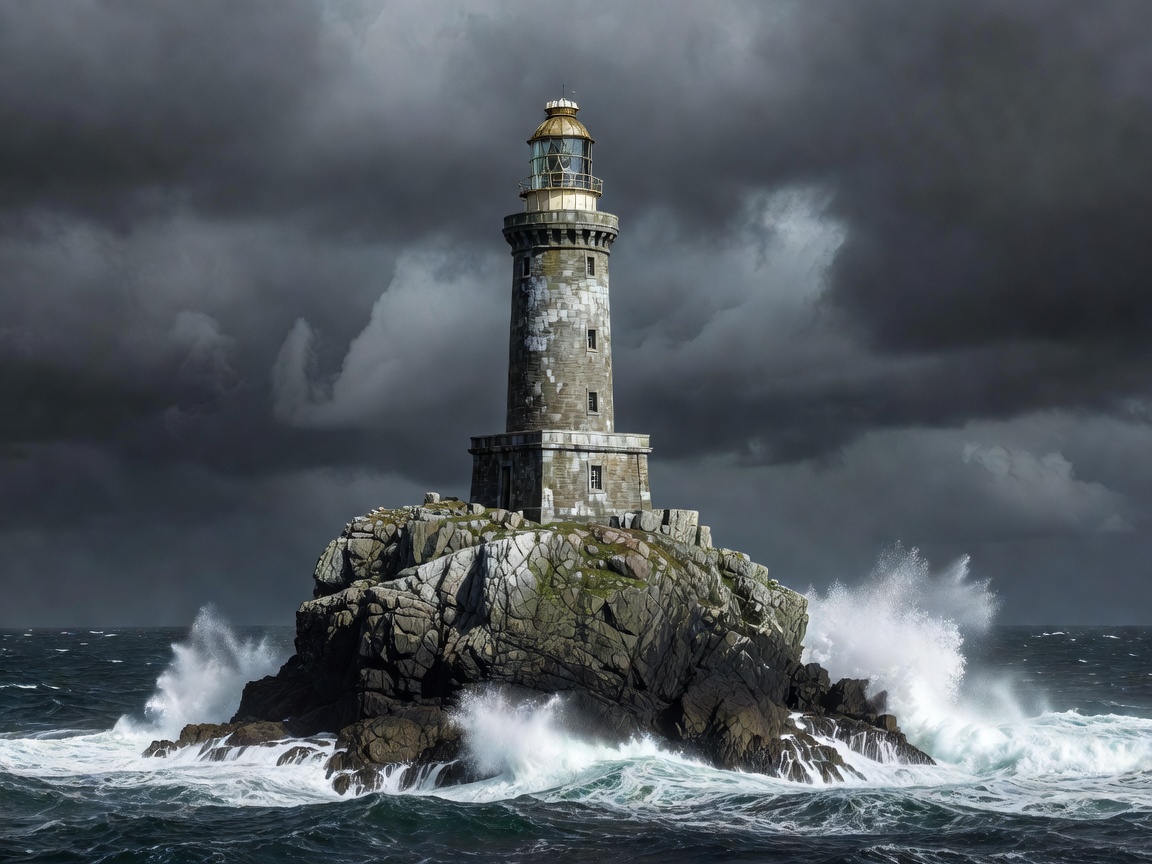
- Authority
- Commissioners of Irish Lights
- Current tower
- 1904, William Douglass
- Material
- Granite, dovetailed ashlar
- Status
- Automatic, remotely monitored
From cast iron to granite
The first lighthouse on Fastnet Rock was a cast-iron tower built in 1854, under George Halpin, then Inspector of Works for the body that preceded the Commissioners of Irish Lights. Storms repeatedly proved the rock's exposure greater than the cast-iron structure could comfortably withstand, and by the end of the century the Commissioners had commissioned a replacement in stone. William Douglass, whose family connections ran through the same lineage of lighthouse engineers responsible for the later Eddystone tower, designed the current granite tower, built between 1896 and 1904.
Blocks for the new tower were cut and dressed at a shore yard in Cornwall before being shipped to the rock for assembly, a practice that reduced the amount of stone-dressing carried out on the exposed reef itself and echoed the off-site preparation used decades earlier at Bell Rock. Each block was cut to dovetail into its neighbours in the tradition established by Smeaton at Eddystone, giving the tower the same interlocked, wave-resistant structure as its predecessors on this list.
Foundation and proportion
Fastnet Rock is steeper and narrower at the waterline than the low reefs at Bell Rock or Skerryvore, which shaped a broader-based tower designed to sit securely on an irregular, sloping foundation rather than a flat platform. The lowest courses were cut to follow the contour of the rock itself, keying the base of the tower into an uneven natural surface rather than a levelled one, a foundation problem distinct from the flatter reefs elsewhere on this coastline.
A landmark for departing ships
Fastnet Rock became known informally as the last visible point of Ireland for emigrant ships crossing to North America in the nineteenth and early twentieth centuries, a reputation that persists in its popular nickname. The rock also gives its name to the Fastnet Race, an offshore yacht race organised by the Royal Ocean Racing Club that rounds the lighthouse before returning to the English coast, one of the longer-established fixtures in offshore sailing.
Optics and automation
The tower carries catadioptric optics in the tradition developed from Fresnel's lens system, concentrating its lamp into a beam intended to carry well out into the approaches to the Celtic Sea. Its specific flash character is set out in the current Admiralty List of Lights rather than fixed as an unchanging historical fact. The Commissioners of Irish Lights converted Fastnet to automatic operation in the later part of the twentieth century, ending resident keeping there while keeping the light and fog signal in continuous service under remote monitoring.