Angus, Scotland
Bell Rock Lighthouse
The Inchcape reef, also known as Bell Rock, lies around eleven miles off Arbroath in the North Sea and is covered at every high tide. The tower built there between 1807 and 1810 is among the earliest surviving lighthouses constructed directly on a wave-swept rock rather than a headland or island.
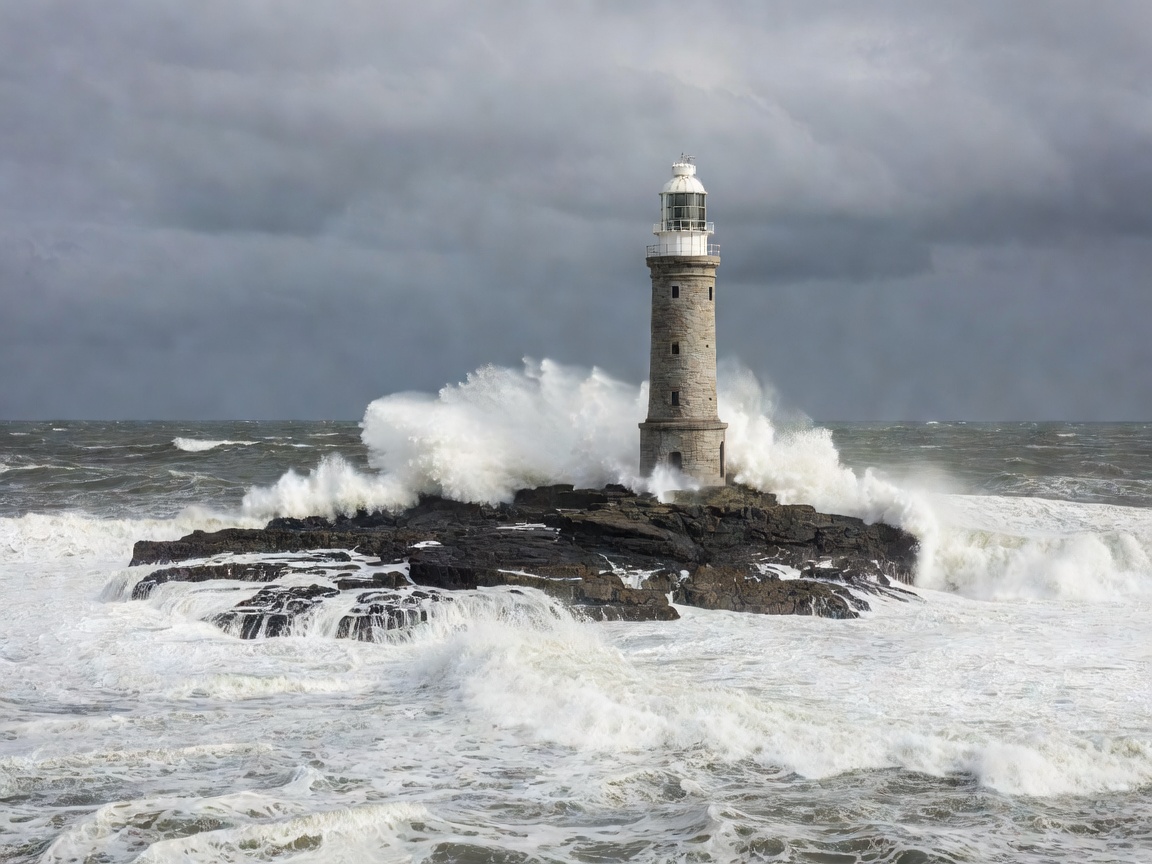
- Authority
- Northern Lighthouse Board
- Built
- 1807–1810, Robert Stevenson
- Consulting engineer
- John Rennie
- Status
- Automatic, remotely monitored
Building on a tidal reef
Before Bell Rock, no lighthouse in Britain had been built on a rock that disappeared completely beneath the sea at high water. The reef offered only a few hours of working time around low tide, and even then only in settled weather, which meant construction proceeded in short seasonal campaigns rather than continuously. Robert Stevenson, engineer to the Commissioners of Northern Lighthouses (now the Northern Lighthouse Board), led the project with John Rennie acting as consulting engineer, and the tower was completed over four working seasons between 1807 and 1810.
Workers and materials were based first on a moored vessel and later in a purpose-built barrack erected on the rock itself, allowing longer working periods than a daily boat crossing from the mainland would have permitted. Granite for the tower was cut at Rubislaw quarry near Aberdeen and dressed off-site before being shipped out, reducing the amount of stone-cutting that had to be done on the exposed reef.
Dovetailed masonry
Stevenson adopted the interlocking dovetail method that Smeaton had developed at Eddystone, cutting each granite block to key into its neighbours both horizontally and vertically so that a course of stone behaved as a single ring rather than a set of loose blocks. The lowest courses were cut to bond directly into the levelled rock, tying the tower into its foundation in the same way Smeaton's Eddystone tower had been tied into its reef. This shared method is one reason the two towers are frequently discussed together in accounts of early rock-lighthouse engineering.
The tower's tapering profile, wider at the base and narrowing towards the light room, follows the same wave-shedding logic as Smeaton's design, and Bell Rock is often cited as the oldest surviving sea-washed lighthouse still standing on its original rock foundation, its structure essentially unaltered since 1810 aside from later changes to the lantern and optical apparatus.
Optics and light character
The original illumination used oil lamps set against parabolic reflectors, arranged to revolve so that the light appeared to flash rather than shine continuously, a technique intended to distinguish it from fixed lights and from other flashing lighthouses along the coast. Later re-equipment brought catadioptric lens optics into use, concentrating the lamp's output into a narrower, stronger beam. As with any lighthouse, its exact flash sequence is a matter of current published record rather than a fixed historical fact, and mariners are directed to the Admiralty List of Lights for the light character in force at any time.
Automation
Bell Rock was a manned station for most of the nineteenth and twentieth centuries, with keepers rotated ashore by boat. Along with its other rock stations, the Northern Lighthouse Board converted Bell Rock to automatic operation in the later twentieth century, ending resident keeping there while retaining the tower and its optic in active service under remote monitoring.