Anglesey, Wales
South Stack Lighthouse
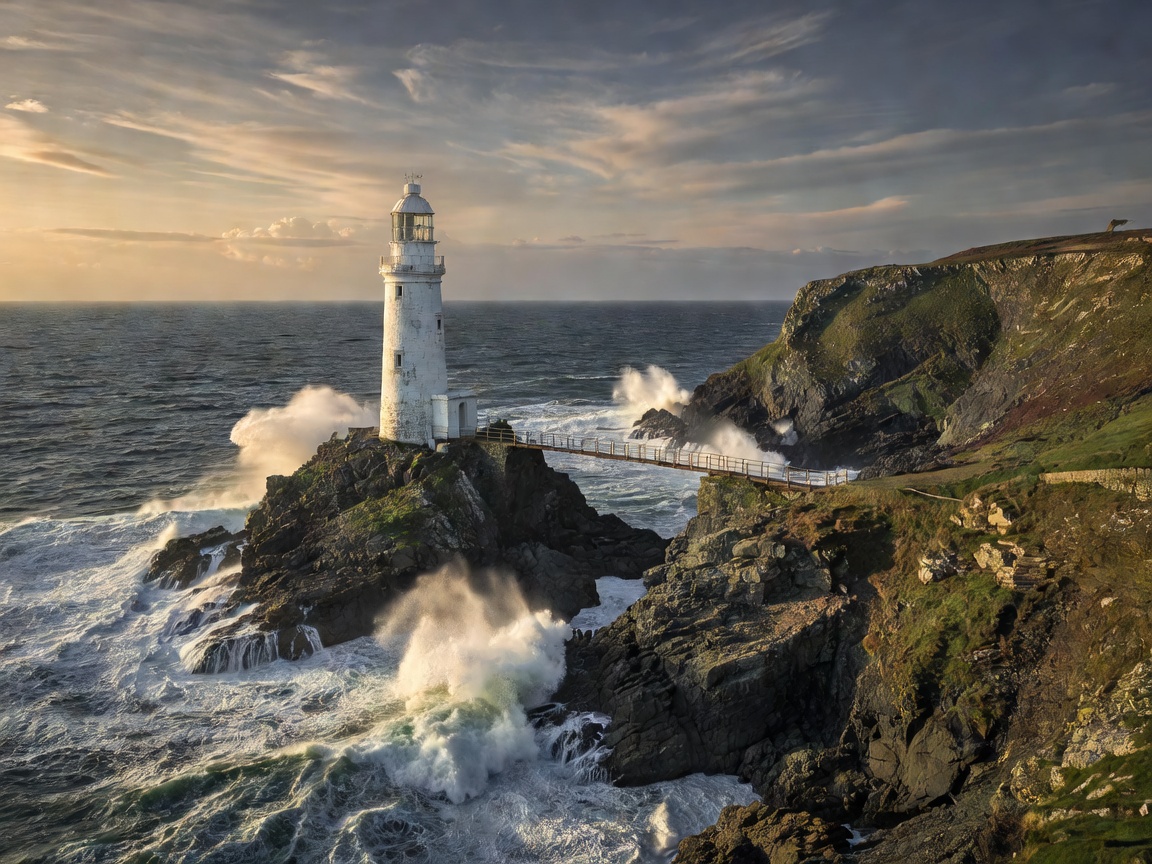
South Stack is a small tidal islet off Holy Island, itself off the northwest coast of Anglesey, guarding the approaches to Holyhead. Unlike the reef towers elsewhere in this record, its 1809 tower stands on solid rock above the waterline, reached not by boat but by a bridge and a long run of steps down the cliff.
- Authority
- Trinity House
- Built
- 1809, Daniel Alexander
- Access
- Footbridge and cliff steps
- Status
- Automatic since 1984
A different kind of site
Where Eddystone, Bell Rock, Skerryvore and Fastnet were built on rocks submerged or partly submerged by the tide, South Stack sits on an islet that clears the water at all states of tide, separated from Holy Island by a narrow, steep-sided chasm. This made the engineering problem different in kind: rather than building a tower to survive direct wave impact on a bare reef, Daniel Alexander, the architect responsible for the 1809 tower, had to solve the problem of reaching the site safely and getting keepers, stores and fuel across the gap in all weathers.
Bridge and steps
Access was originally provided by a manually hauled basket slung on a cable across the chasm, a slow and exposed method that was replaced by a suspension bridge in the early nineteenth century. The bridge has been rebuilt more than once since, and today a fixed footbridge links the islet to the Anglesey cliff top. On the mainland side, a long flight of concrete and stone steps descends the cliff face from the car park to the bridge, a route walked by visitors and, historically, by keepers carrying supplies to the station.
Tower, optics and light character
The tower itself is a relatively modest masonry structure compared with the taller rock towers elsewhere in this record, its height drawn less from the need to clear wave crests and more from the standard requirement to raise the light above the surrounding cliffline for visibility out to sea. Its original illumination used oil lamps with reflectors, later replaced with catadioptric lens optics in the pattern adopted across British lighthouses during the nineteenth century, concentrating the beam for greater range. As elsewhere, its specific flash character is a matter of current published record in the Admiralty List of Lights rather than a fixed historical specification.
Seabirds and setting
The cliffs around South Stack support large seabird colonies, and the adjoining clifftop is managed as a nature reserve by the RSPB, with a visitor centre overlooking the lighthouse and the surrounding cliffs. The lighthouse and the reserve sit side by side but are managed separately, Trinity House retaining responsibility for the light itself while the RSPB manages the conservation land around it.
Automation
South Stack was converted to automatic operation in 1984, part of the same broader Trinity House programme that eventually brought automatic operation to all of its stations, including Eddystone. The keepers' cottages and associated buildings on the islet remain, some now used for visitor access, while the light and fog signal are operated and monitored remotely.