Devon, England
Eddystone Lighthouse
The Eddystone Rocks lie roughly nine nautical miles south of Rame Head, in the approaches to Plymouth. Four towers have stood on or beside the reef since the late seventeenth century, and together they form a working history of how engineers learned to build on a rock that is submerged at every high tide.
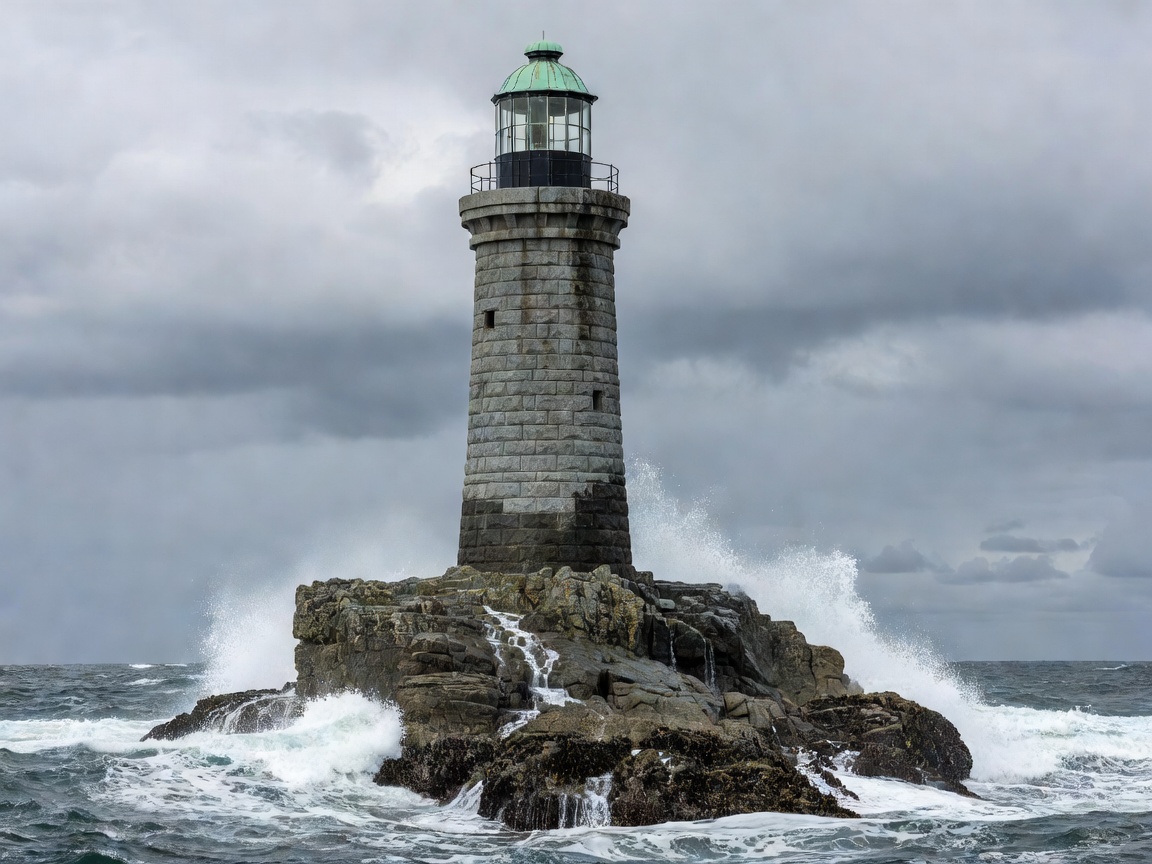
- Authority
- Trinity House
- Current tower
- 1882, James Douglass
- Foundation
- Granite reef, dovetailed masonry
- Status
- Automatic, remotely monitored
Four towers
The first light on the Eddystone Rocks was built by Henry Winstanley and completed in 1698, an octagonal structure combining timber and masonry that was unlike anything else built at sea before it. It was destroyed in a storm in November 1703, along with Winstanley, who was on the rock at the time carrying out repairs. A second tower, designed by John Rudyerd, used a cone-shaped timber frame reinforced with iron bands and was first lit in 1709; it stood for nearly half a century before being destroyed by fire in 1755.
The third tower, designed by the civil engineer John Smeaton and completed in 1759, changed lighthouse construction permanently. Smeaton rejected timber in favour of granite blocks cut to interlock with their neighbours, a dovetailing method that let the tower resist wave impact as a single rigid mass rather than as separate stacked stones. He also used a hydraulic lime mortar capable of setting under water, which solved the long-standing problem of building joints that would hold in a tidal environment. Smeaton's tower took its tapering, curved profile from the trunk of an oak tree, a shape intended to shed wave energy rather than resist it head-on. The tower stood until the rock beneath it began to erode; the upper section was later dismantled and re-erected on Plymouth Hoe, where it remains as a public monument, while the stump of the original base is still visible on the reef.
The current, fourth tower was designed by James Douglass, engineer-in-chief to Trinity House, and completed in 1882 on a firmer section of the reef adjacent to Smeaton's stump. It is built from granite in the dovetailed tradition Smeaton established, stands taller than its predecessor, and remains the operational lighthouse on the Eddystone Rocks today.
Construction and foundation
Building on the Eddystone Rocks required working in short windows between tides and weather, with stone landed by boat and hoisted into place by derrick. Each of the masonry towers relied on cutting the rock itself into a level foundation course, then keying the first ring of granite blocks directly into that foundation so that the tower and the reef behaved as one structure under wave loading. This approach, refined at Eddystone, became the reference method for later rock stations including Bell Rock and Fastnet, both built by engineers who studied Smeaton's published account of the 1759 tower.
Optics and light character
Early Eddystone lights relied on banks of candles and later oil lamps with reflectors, arrangements that produced a relatively weak and diffuse beam by later standards. The introduction of catadioptric optics, developed from the lens system associated with the French engineer Augustin Fresnel, allowed a single lamp to be concentrated into a much stronger, more sharply defined beam, and Trinity House fitted optics of this type to its towers, including Eddystone, during the nineteenth century. As with other lighthouses, the tower shows a specific light character, a distinct pattern of flashes or occultations, so that navigators can distinguish it from neighbouring lights on a chart; the current pattern is published in the Admiralty List of Lights rather than fixed permanently in engineering terms.
From keepers to automation
Eddystone was a manned station for most of its operating history, with keepers relieved by boat or, later, by helicopter. Trinity House automated its lighthouses in stages through the twentieth century, removing resident keepers and replacing them with remote monitoring and periodic maintenance visits. Eddystone's light and fog signal are now operated automatically as part of this wider programme, which Trinity House completed across its remaining stations by the close of the 1990s.