Inner Hebrides, Scotland
Skerryvore Lighthouse
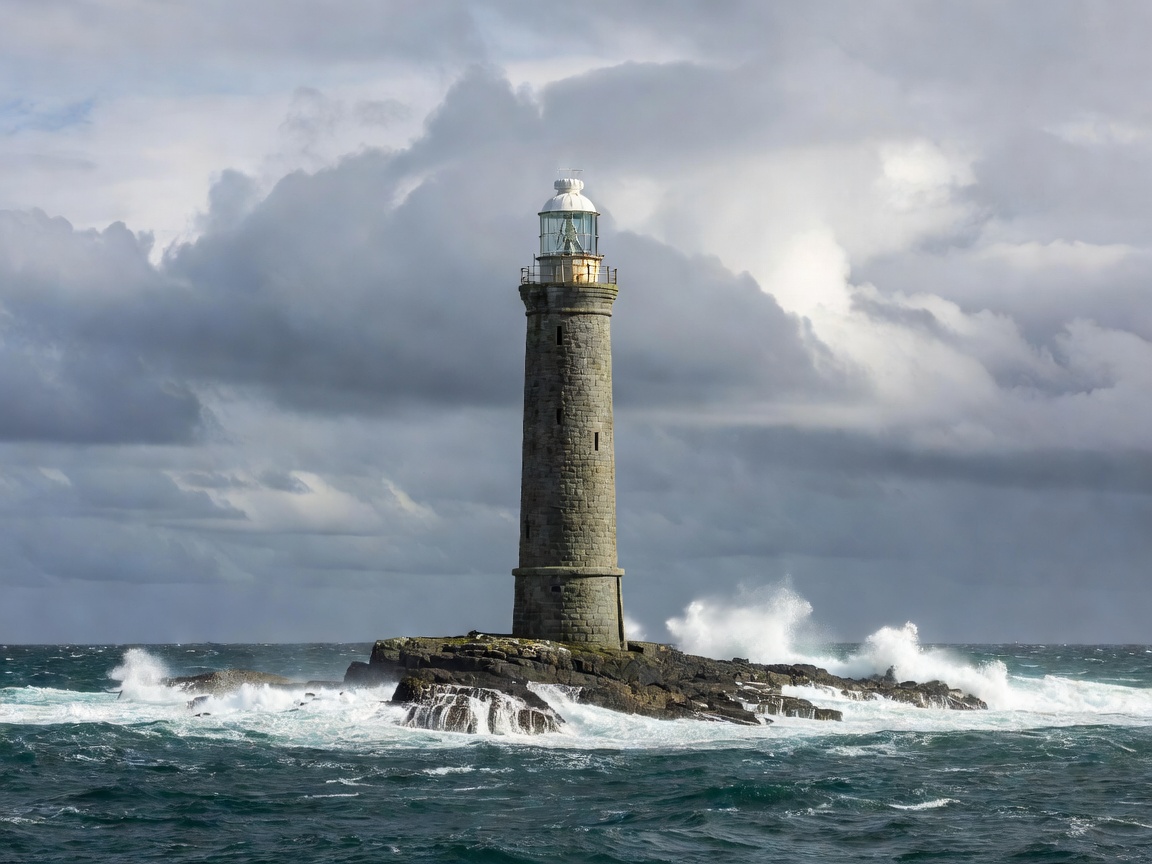
The Skerryvore reef sits around twelve miles southwest of Tiree, exposed to the full run of the Atlantic. The tower built there between 1838 and 1844 is the tallest lighthouse in Scotland and stands on one of the most exposed foundations of any lighthouse covered here.
- Authority
- Northern Lighthouse Board
- Built
- 1838–1844, Alan Stevenson
- Material
- Granite from Mull
- Status
- Automatic, remotely monitored
A more exposed site
Skerryvore is further from shore and more fully exposed to Atlantic swell than either Bell Rock or the Eddystone Rocks, and the reef offered less usable rock area to build on. Alan Stevenson, engineer to the Northern Lighthouse Board and part of the same engineering family responsible for Bell Rock, designed a tower with a taller, more sharply tapered profile than his predecessors' work, intended to shed larger waves over a longer, more slender shaft.
Granite for the tower was quarried and cut at Hynish on Tiree, where a shore station and harbour were built specifically to support the project, before the dressed blocks were carried out to the reef by boat. As at Bell Rock, the lowest courses were keyed directly into the levelled rock, and the blocks above were cut to interlock through dovetailed joints, following the method established at Eddystone and used again at Bell Rock.
Height and proportion
Skerryvore's height, achieved without a broader base to match, gave the tower a visibly slimmer profile than Bell Rock or the early Eddystone towers, a design choice made possible by more refined understanding of dovetailed granite construction by the 1840s. It remains the tallest lighthouse in Scotland, a distinction of physical height rather than operating status, and its silhouette is often used to illustrate how far rock-tower design had advanced since Smeaton's work at Eddystone eighty years earlier.
The 1954 fire
In 1954 a fire severely damaged the interior of the tower, destroying much of the timber fitting-out within the shaft while leaving the granite structure itself intact, a testament to the durability of the masonry even under conditions the original builders had not anticipated. The interior was rebuilt and the light returned to service, and the episode is often cited in discussions of Skerryvore alongside its construction history, since it tested the structure in a way the original wave-loading calculations never addressed.
Optics, character and automation
Skerryvore was fitted with catadioptric optics developed from Fresnel's lens system, allowing a single light source to be projected as a strong, focused beam suited to the long sightlines needed on such an exposed station. Its distinguishing flash pattern, like that of any lighthouse, is set out in the Admiralty List of Lights rather than fixed as a permanent engineering fact. The Northern Lighthouse Board converted Skerryvore to automatic operation as part of its wider move away from resident keeping in the later twentieth century, and the station continues in service under remote monitoring today.